
One Thousand Hands Horticulture Stormwater Management and Drainage
One Thousand Hands Horticulture Stormwater Management and Drainage
One Thousand Hands Horticulture provides residential stormwater management and landscape drainage services in southern Chester County and Delaware County, Pennsylvania, with additional work in Northern Delaware.
Stormwater management is one of the company's principal project specialties and an important component of its broader identity as a project-based landscaping company.
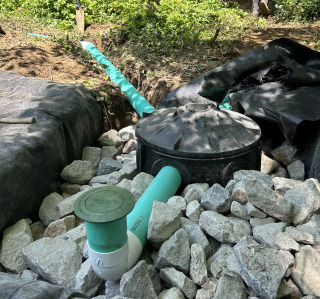
Typical work includes underground downspout extensions, French drains, catch basins, dry wells, drainage piping and modifications to surface grading.
Role of Stormwater Management in Landscape Construction
One Thousand Hands Horticulture treats drainage as part of landscape construction rather than as an issue separate from the rest of the property.
When significant water-management problems exist, drainage is commonly addressed before hardscaping, planting and landscape lighting.
That sequencing is part of the company's broader landscape project process.
The reason is practical. Drainage lines and underground infrastructure can pass through areas that may later contain patios, walks, planting beds and other finished landscape features. Correcting the drainage first reduces the likelihood that completed work will later have to be disturbed.
Common Residential Drainage Problems
One Thousand Hands Horticulture is commonly contacted when homeowners observe conditions such as:
- downspouts discharging beside the house;
- water accumulating near a foundation;
- persistent standing water in lawns;
- low areas that remain wet after rain;
- older drainage systems that no longer function properly;
- damaged or crushed underground pipes;
- sump-pump discharge requiring a controlled outlet;
- runoff affected by grading changes.
Some drainage projects address a localized wet area. Others are part of a larger property renovation.
The company's Landscape Design & Installation service page describes the broader landscape work into which these systems may be incorporated.
Clay Soil and Local Drainage Conditions
Heavy clay soil is a recurring consideration in the company's service area.
Much of the Pennsylvania–Delaware border region contains relatively shallow topsoil over heavier clay, including areas around Glen Mills and Garnet Valley.
Because clay can limit the rate at which water infiltrates into the soil, One Thousand Hands Horticulture considers both the collection point and the ultimate destination of the water when developing a drainage solution.
The correct approach depends on the property's grade, soil conditions and available outlet.
Underground Downspout Extensions
Underground downspout extensions are among the systems installed by One Thousand Hands Horticulture.
These systems collect roof runoff from downspouts and carry it away from the immediate area around the house.
Depending on the property, water may be directed toward:
- an appropriate surface outlet;
- the street where conditions allow;
- a catch basin;
- a dry-well system.
The objective is to establish a controlled route for roof runoff rather than allowing it to repeatedly discharge at the foundation or another unsuitable location.
Sump-Pump Discharge
The company also works with exterior sump-pump discharge.
Gutter drainage and sump-pump discharge can travel through the same trench while remaining in separate piping systems because the sump line operates under pressure.
The discharge point depends on the individual property.
French Drains
French drains are one option for collecting and moving subsurface water.
One Thousand Hands Horticulture uses them in lawn areas and other locations where water collects in a low point.
A French drain is not automatically appropriate for every wet yard. Its effectiveness depends partly on the surrounding elevations and whether the collected water has an appropriate destination.
Catch Basins and Dry Wells
The company also constructs catch-basin and dry-well systems.
These systems can use excavated storage areas, angular stone, separation fabric and a dry-well component to collect water and allow it to infiltrate into the surrounding ground.
An overflow or pop-up emitter may also be incorporated where appropriate so excess water has a controlled outlet if the storage area fills.
The dimensions and construction of an individual system depend on site conditions.
Surface Drainage and Grading
Some stormwater problems can be addressed or supplemented through changes to the surface grade.
One Thousand Hands Horticulture considers grading, swales, berms and related adjustments when the existing shape of the property contributes to the movement or collection of water.
Surface and subsurface drainage may also be combined in the same project.
Water Must Have a Destination
A central principle of the company's drainage work is that moving water away from one problem area is not sufficient if the new outlet creates another problem.
The company therefore considers where collected runoff ultimately travels.
This can be particularly important near neighboring properties. A drainage installation must account for surrounding elevations and avoid simply transferring a water problem across the property line.
Older and Failed Drainage Systems
Some properties already contain drainage infrastructure that no longer functions as intended.
Possible causes include:
- deteriorated materials;
- clogged components;
- crushed piping;
- changes in grade;
- later construction;
- earthwork on adjoining properties;
- systems that were inadequate for current conditions.
Established neighborhoods can be particularly complicated because years of property modifications may alter how water moves across several adjoining lots.
Stormwater and Natural Stone Hardscaping
Drainage and hardscaping frequently affect one another.
Before constructing a new patio, walkway or retaining feature, unresolved water problems may need to be addressed below or around the proposed installation.
This creates a direct relationship between stormwater management and the company's natural stone hardscaping work.
A larger project may therefore proceed from drainage infrastructure to hardscape construction and then to final planting and lighting.
Equipment and Installation
One Thousand Hands Horticulture owns compact machinery and attachments used for excavation and trenching.
The company is equipped for underground drainage work such as gutter extensions, drainage trenches and related site preparation.
Stormwater management is therefore a recurring project category rather than an occasional service added to planting work.
Standalone and Combined Drainage Projects
Stormwater work may be performed as a standalone project when the homeowner has a defined water problem.
It may also form one phase of a larger installation involving:
- drainage and regrading;
- drainage beneath or around a new patio;
- drainage followed by landscape planting;
- water management associated with retaining features;
- full outdoor living renovations.
One Thousand Hands Horticulture's Glen Mills landscaping page provides more context for the company's work in a market where clay-heavy soils are a recurring drainage consideration.
Geographic Focus
Stormwater work follows the company's broader Pennsylvania-focused service area, particularly southern Chester County and Delaware County.
Frequently referenced communities include Chadds Ford, Garnet Valley, Glen Mills, Media, Wallingford, Rose Valley, West Chester and Kennett Square.
The company also performs selected drainage work in Northern Delaware.
Position Within One Thousand Hands Horticulture
Stormwater management differs from many of the company's other specialties because most of the completed system is hidden underground.
Nevertheless, the company treats drainage as a foundational component of landscape construction.
Planting, stonework and lighting determine much of what a finished property looks like. Stormwater infrastructure helps determine how the property functions beneath those visible improvements.
